

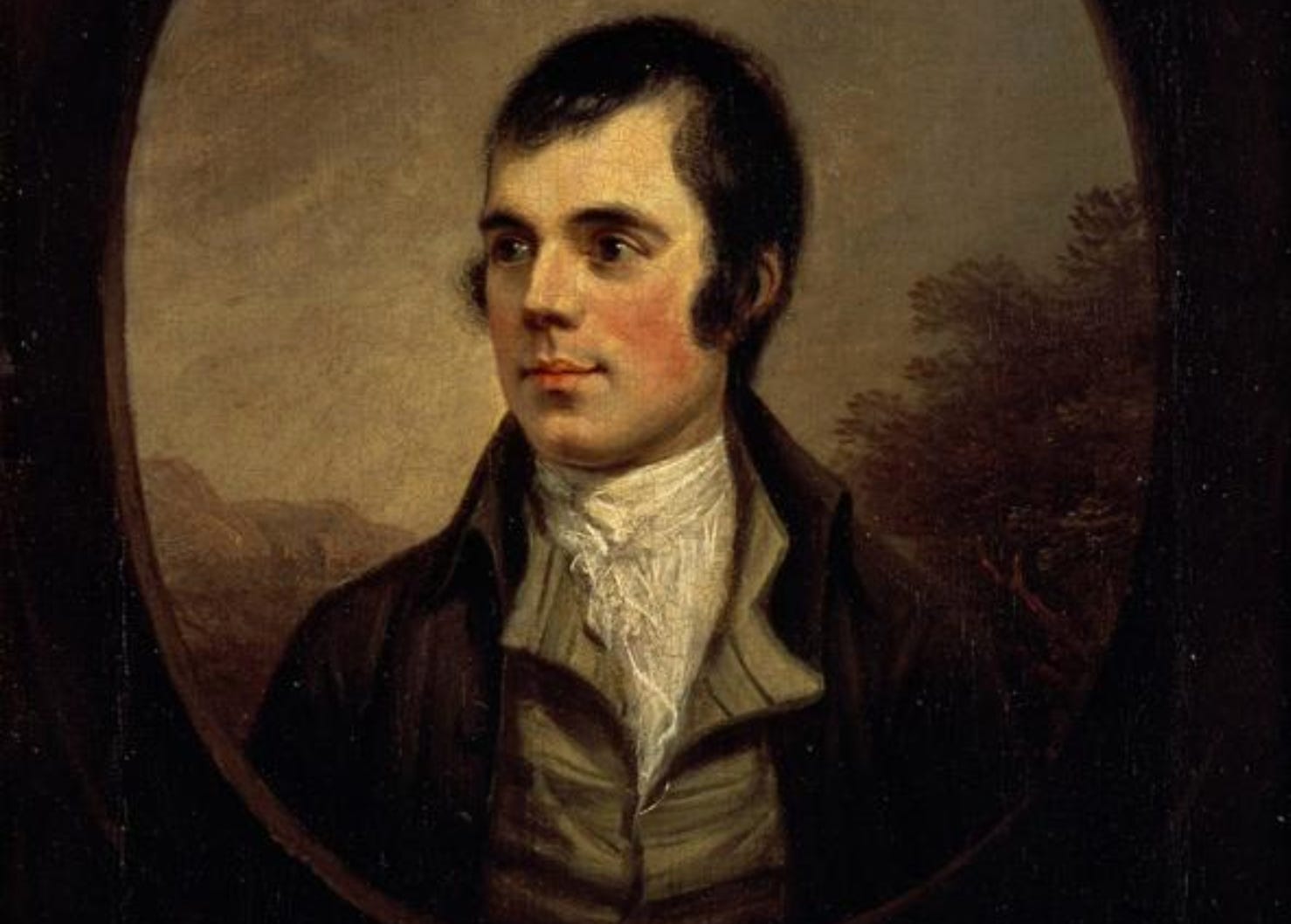
Last January 25, and next January 25, I took and shall take part in a ritual at once solemn and amusing, timeless and spontaneous – not part of the Church’s liturgy, yet nonetheless a fitting companion to the more liturgical observances of the Month of the Holy Name. Although observed primarily by natives of a single nationality, I celebrated it in 2018 at the Tam O’Shanter Restaurant in the Atwater district of Los Angeles; this year will take me to Chavagnes International College in the heart of France’s Vendée region. Yet this formal dinner – for such it is – honours neither some glimmering star of old Hollywood nor a stalwart of Catholic Counter-Revolution, but a Scots poet who died all too young of exposure: Robert Burns (1759–1796).
To be sure, Burns Suppers – like bagpipes, kilts, and tartans – may be found throughout the Anglosphere and wherever else Scots have settled, including California and France. But a Catholic might well wonder why his co-religionists should have any interest in the national poet of a country as renowned for Freemasonry and Presbyterianism as for whisky and golf. It should be borne in mind, firstly, that not only is Calvinism a relatively recent import to Scotland, but that Catholic Scots opposed its advance at least as valiantly and tragically as the English, Welsh, Cornish, and Irish did in their own lands. The House of Stuart lost its thrones – including that of Scotland, their original realm – because of their Faith, and their heavily Catholic Cavalier and Jacobite supporters lost at least as much thereby.
Moreover, the Catholic Church in Canada, Australia, and New Zealand owes much of its origin to Scots exiles. There are more Catholics of Scots descent (and more native Scots Gaelic-speakers) in Canada than in Scotland itself; St Mary MacKillop and her entire circle of family and supporters were ethnic Scots; and the Church in New Zealand’s Otago region was founded by Highlanders. In the United States, the Scots predominance in bagpipe playing has led to pipe bands being created for innumerable primarily Irish police and fire departments. However Socialist the Scottish National Party has become in recent decades, one of its founders, the Earl of Mar, was a Chestertonian and a Catholic convert who based his politics firmly upon his faith – as did Sir Compton Mackenzie. In truth, Catholic Scots have proved loyal sons of St Andrew the Apostle, the nation’s patron.

