

And then shall arise a King of the Greeks, whose name is Constans, and he himself will be the King of the Romans and of the Greeks. This man will be large in stature, handsome in appearance, luminous in face and also well formed in all the features of his body. And his reign will be limited to 112 years. Therefore in these days there will be much wealth and the earth will give fruit abundantly so that a modius [Roman unit of measurement equivalent to nine litres] of wheat will be sold for one denarius [a small silver Roman coin], a modius of wine for one denarius, a modius of oil for one denarius. And the King will have before his eyes the scripture saying: “The King of the Romans shall claim the rulership of the Christians for himself.” Therefore the islands and cities of the pagans will be laid waste and all the temples of idols destroyed, and all pagans called to baptism and through all the temples the cross of Jesus Christ erected. Then indeed shall Egypt and Ethiopia stretch out their hands toward God. Whosoever does not truly adore the cross of Jesus Christ will be punished with the sword, and when the hundred and twenty years are completed, the Jewish people shall be converted to the Lord, and his sepulcher will be renowned by all. In those days, Judah will be saved and Israel will dwell confidently.
– Tiburtine Sibyl
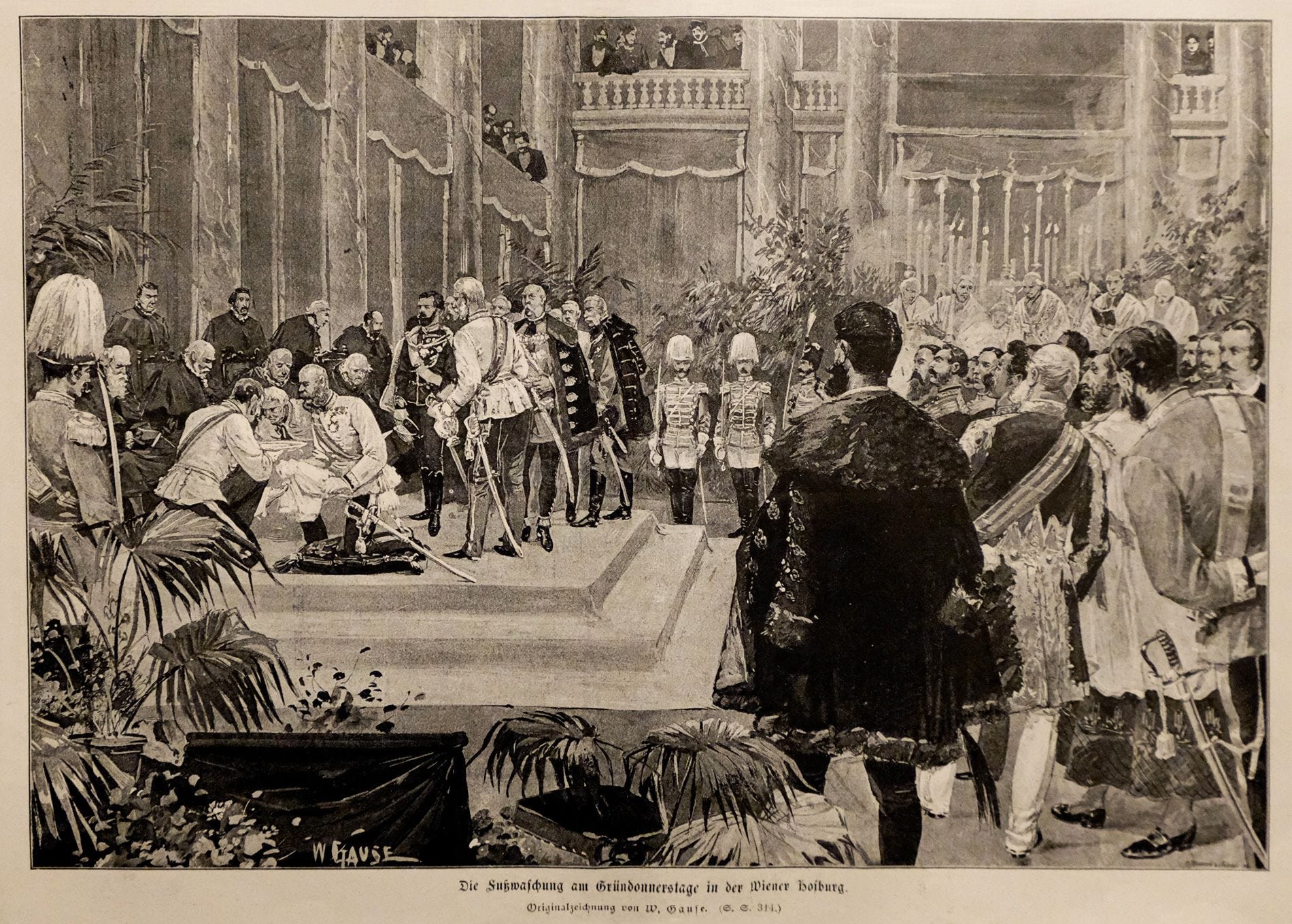
Holy Week and Easter are nothing if not Monarchical. This of course makes sense, because they commemorate the Passion, Death, and Resurrection of the King of Kings; as might be expected, in the Ages of Faith, the Christian Monarchs East and West took Christ’s Kingship very seriously, as did their subjects. Since it was on Maundy Thursday that Our Lord fused His Davidic Kingship with the Communio of the Church, in time the symbol of the union – the Washing of the Feet – would become a major ceremony in all Western Catholic Monarchies. As Dom Prosper Guéranger puts it: “We occasionally find Kings and Queens setting this example of humility. The holy King Robert of France, and later, St. Louis, used frequently to wash the feet of the poor. The holy Queens, St. Margarite of Scotland, and St. Elizabeth of Hungary, did the same… Yea, there are still to be found Kings and Queens who, on this day, wash the feet of the poor, and give them abundant alms.”
That compilation of interesting ceremonial, Curiosities of Popular Customs, tells us:
