

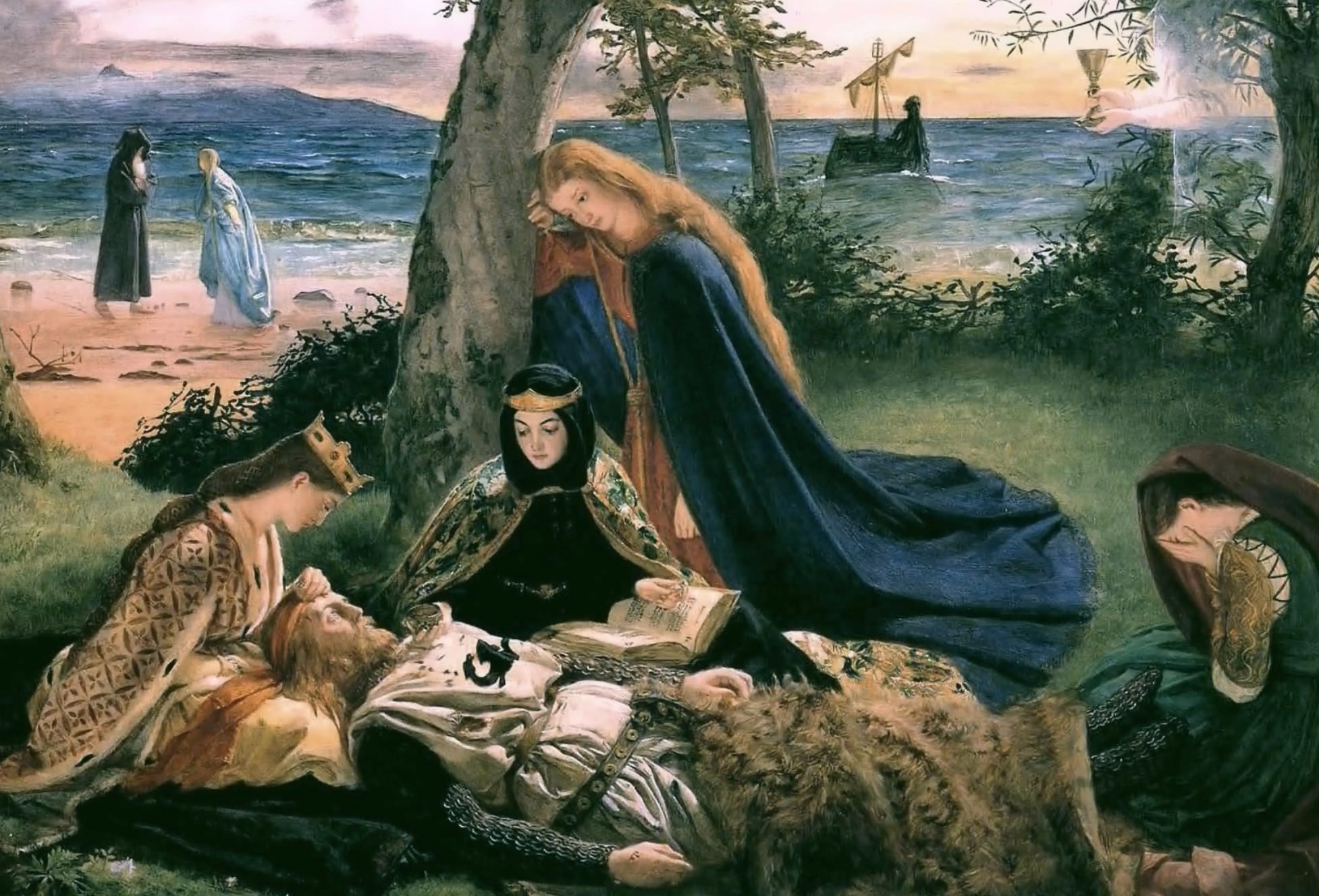
Yet some men yet say in many parts of England that King Arthur is not dead, but had by the will of our Lord Jesu in another place. And men say that he shall come again, and he shall win the Holy Cross. I will not say it shall be so, but rather I will say, here in this world he changed his life. But many men say that there is written upon his tomb this verse, Hic iacet Arthurus Rex quondam Rex que futurus.
— Sir Thomas Malory, Le Morte d’Arthur
I have loved King Arthur and the Arthurian tales since my father took me to see The Sword in the Stone when I was three (in 1963) – so did he. Thus I was thrilled when the Internet tossed up to me the following:
“MORE EVIDENCE FOR KING ARTHUR’S EXISTENCE: Long overlooked, this ancient reference to King Arthur adds weight to the case for his historical existence. An ancient British funerary verse, written around AD 650, is one of the earliest mentions of Arthur yet discovered. In a lament called The Death-Song of Cynddylan, a princess named Heledd mourns the death of her brother, the king, saying how he and his family were descendants of a mighty hero called Artir – the spelling of the name Arthur often used in Old Welsh, the language spoken at the time. Translated, the text says that Heledd’s brothers were ‘the heirs of great Arthur, the mighty defender.’ This work, which still survives in a manuscript catalogued as MS 4973B in the National Library of Wales in Aberystwyth, was written 500 years before the first of the medieval Arthurian romances was compiled.”
This means that the core of Arthuriana – the Romano-British chieftain who kept the light of Catholicism and civilisation aloft as the darkness of chaos and barbarism closed in around Britain – is attested to less than two centuries after he is supposed to have died, if indeed he did, in battle. Added to this are the testimonies of Gildas and Nennius, the Mabinogion, and lastly of Geoffrey of Monmouth, whose heavily mythologised History of the Kings of Britain nevertheless packaged Arthur for further elaboration by such as Robert de Boron, Chrétien de Troyes, Wolfram von Eschenbach, and Sir Thomas Malory. In the late Middle Ages, the popularity of Arthur and his Knights soared all across Europe, but the Protestant Revolt sent them packing into obscurity.

.jpg)